
If one won’t deceive themselves, AI has given the impression of being a magical tool. The reason is that in today’s time, AI is performing very well and in the best way, providing remarkable results in a very short time.
With various AI tools having saturated the market, one that has shown to be well revered is the Face Swaps AI. The technique used for this specific AI tool is called face swapping. What it entails is that you change the real face with another face in any photo or video. Now how can we replace our face with Face swapper AI in someone else’s photo or video so we can resemble any kind of celebrity or anyone we want?
The Basics of Face Swapping
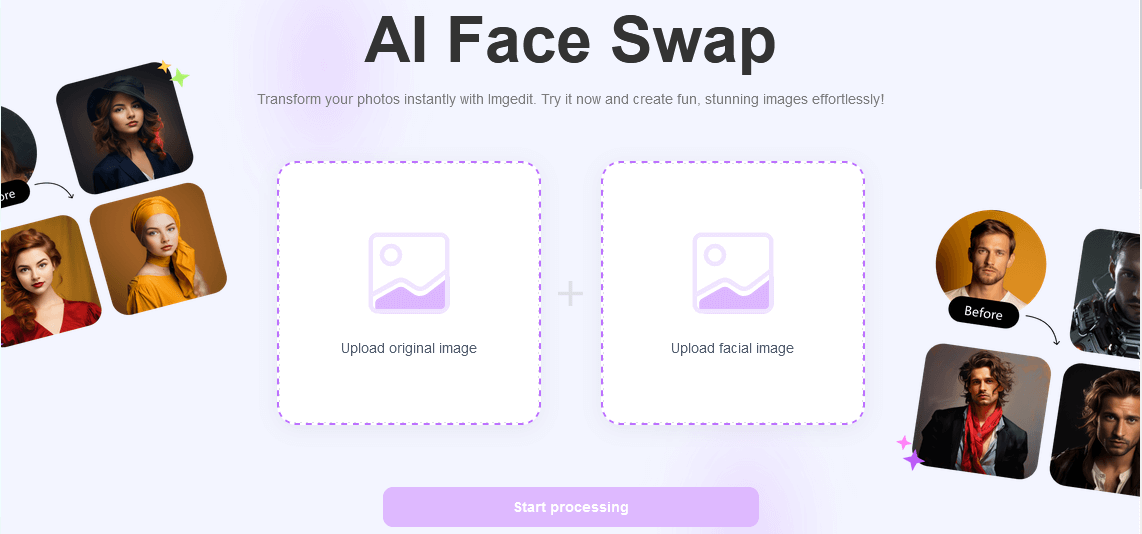
Face Swap AI is a tool that opens up a world of creative possibilities by endlessly changing the facial features in images. Typical processes of how it works include:
- Uploading Base Image
The first process is uploading a photo or selecting a template as your base image.

- Uploading the Second Image
The next process is providing another photo featuring a clear face. In this case, the AI technology recognizes the facial features in this image.
- Recognition and Replacement
The AI recognizes the facial features in the image and replaces them with those from the uploaded photo.
- Achieve the Result
Finally, wait and experience the magic as the face swap swiftly achieves the effect effortlessly.
Meeting the Needs of Multiple Scenarios
The face swapper AI is far past simple swaps. While it caters to a variety of scenarios, it likewise caters to numerous creative endeavors. Some of them are:
- Basic Face Swap
This is the fundamental use of the face swapper AI tool. The tool revolves around swapping the face of one into another, hence providing amusing and captivating transformations. Many templates are available to help in swapping faces to individual preferences whether it’s swapping faces with friends, family, or even celebrities.
The face swapper AI features an advanced AI technology that goes beyond simply swapping a face from one image to another. On the other hand, it gives room for compatibility adjustments while also ensuring the swapped images are unified, while also achieving a fusion of the two faces.
Core Technology
The Foundation of Facial Recognition
Numerous strategies are used by face recognition to authenticate and identify individuals through facial features. With this biometric technology that operates by scrutinizing unique facial patterns, a non-intrusive approach for identity verification in security, finance, and everyday applications is made available. Face recognition comes across challenges owing to the details of facial features instead of typical object classification. While it involves handling numerous classes (individual faces) with subtle differences, it also handles significant variations within the same individual due to factors like pose, lighting, expressions, age, and occlusions.
A known subset of machine learning known as deep learning plays a crucial role when it comes to modern face recognition. These methods utilize deep neural networks that comprehend multi-level representations of facial features, hence allowing easy detail capturing of various levels. With this hierarchical structure, the models can identify faces effectively, while showcasing resilience to changes in facial pose, lighting, and expressions.
Challenges and Limitations of Multiple Face Swapping
Lighting and Angle Consistency
Even though these face swapping tools are well efficient, they also have their own challenges and limitations. One of the challenges is maintaining consistency in lighting and angle between the source and target images. Lighting conditions influence the facial features and their appearance. Even slight changes in camera angle can influence the accuracy of this swap. To achieve endless results, algorithms have to be stocked enough to provide the environment for these variations to adjust the swapped face accordingly.
Occlusions and Facial Hair
Certain occlusions such as hair, glasses, or hands blocking certain parts of the face can slightly affect face swapping algorithms. To accurately map and replace facial features in the presence of occlusions, advanced techniques are required to oversee this missing information. Likewise, facial hair also poses a unique challenge, as is evident in their knack for distorting facial features and creating inconsistencies in the swapped face.
Important ethical concerns also result in the increasing sophistication of face swapping technology. A special type of face swap known as Deepfakes can be used to create highly convincing or harmful content. The possibility of misusing them for identity theft, defamation, and the spread of misinformation, needs to be considered carefully. Hence, it necessitates the need to establish ethical guidelines and regulations to avoid the irrelevant use of these face swapping technology.
Plus, the use and distribution of these deepfakes without consent can be termed as an infringement on individuals’ privacy rights. Whereas, It is crucial to respect individuals’ privacy while obtaining the necessary permissions before utilizing their likeness for face swapping purposes. Over the years, face swapping technology continues to evolve, hence making it imperative to balance innovation with ethical responsibility.
Future Developments in Multiple Face Swapping
Real-Time Face Swapping
Face-swapping technology is not functional without its real-time application. View a scenario where video calls or live streams allow faces to be swapped endlessly as the conversation goes on. Merely thinking about this will surely revolutionize video conferencing, entertainment, and virtual reality experiences. Likewise, the advancement in processing power and algorithm efficiency are important for achieving this milestone.
Enhanced Realism and Accuracy
Challenges like lighting inconsistencies, facial expressions, and hair occlusion often affect the current face swapping techniques. Hence, future developments will be based on finding a way to overcome these limitations to incite even more realistic and seamless swaps. This will revolve around refining and upgrading these algorithms to better comprehend facial features and adapt to any condition.
Immense potential for both positive and negative applications is foreseen in the coming years for face swapping. Hence, striking a balance between technological advancement and ethical responsibility is imperative to ensure this technology creates a suitable benefit for society as a whole.
Conclusion
Compared to recent years, face swapping technology has evolved, while offering both exciting possibilities and significant challenges. Right from their potential of use in the entertainment industry to creating deepfakes, their impact cannot be overlooked. While also promising a future of beneficial digital experiences, it will also create a robust medium ethical framework to prevent improper use.
